
Worknehs and Hakas
How God uses His people to reach cultures

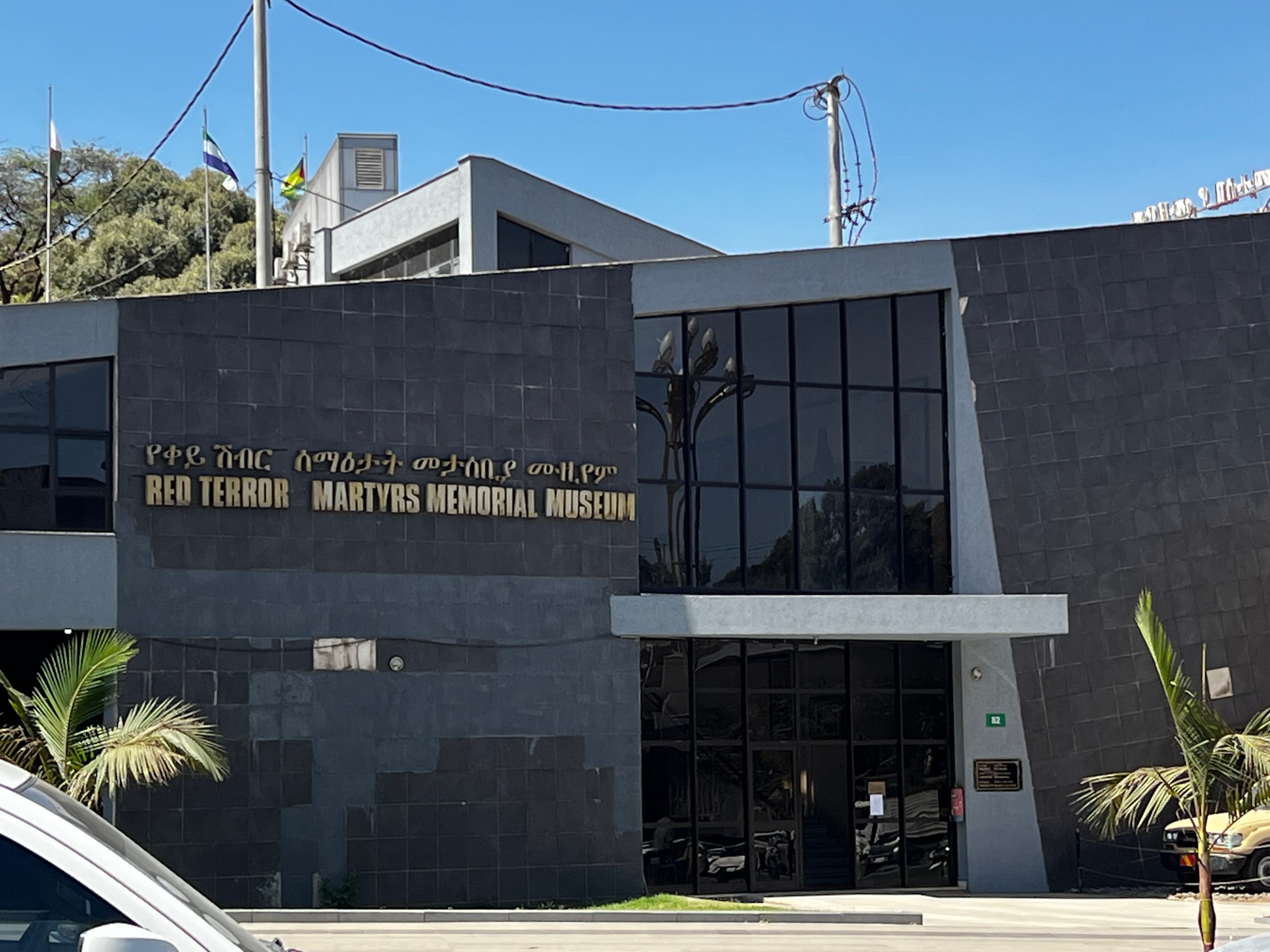
Hanging in the Red Terror Martyrs Memorial Museum in Addis Ababa, Ethiopia, is a photograph. In it are young men on their way to their execution. All were executed save one. Workneh Tesfaye was spotted by a relative who happened to be standing on a balcony overlooking the men that day. He quietly told the guards to pull Workneh aside. Workneh was just a teenager.
When Workneh sees the picture, he sees the execution of his friends. The state captured this moment during a dark period in Ethiopian history. But Workneh also sees something else. He sees the hand of God on his life to serve Someone greater. Like Joseph in the Bible, he realizes that what man intended for evil, God can use for good. Or to put it a little differently: God can draw a straight line with a crooked stick.
Workneh joined his extended family in the United States. Sensing God’s call on his life, he told his wife he would start churches among Ethiopians, and that her work would help free him for ministry. His goal was to plant churches first in the U.S., and then to build an unseen but powerful cross-continental bridge back to Ethiopia to reach more Ethiopians for Jesus. God saved an Ethiopian to reach Ethiopians. The boy scheduled for execution became the man seeking to reach his executioners for Christ.
As it turns out, Ethiopian ministries often run along familial lines. Family members extend out to cousins who marry and extend out to others. In the U.S., these bonds become particularly powerful and important. Immigrants seek both to hold onto their homelands while also embracing a new home. Soon, Workneh had planted churches, first in Nashville and then in Boston (where he lives today). And he did build a bridge to Ethiopia, traveling there often to visit his sister (now a Christian missionary), establish ministries to reach the unreached, and forge a network of partnerships.
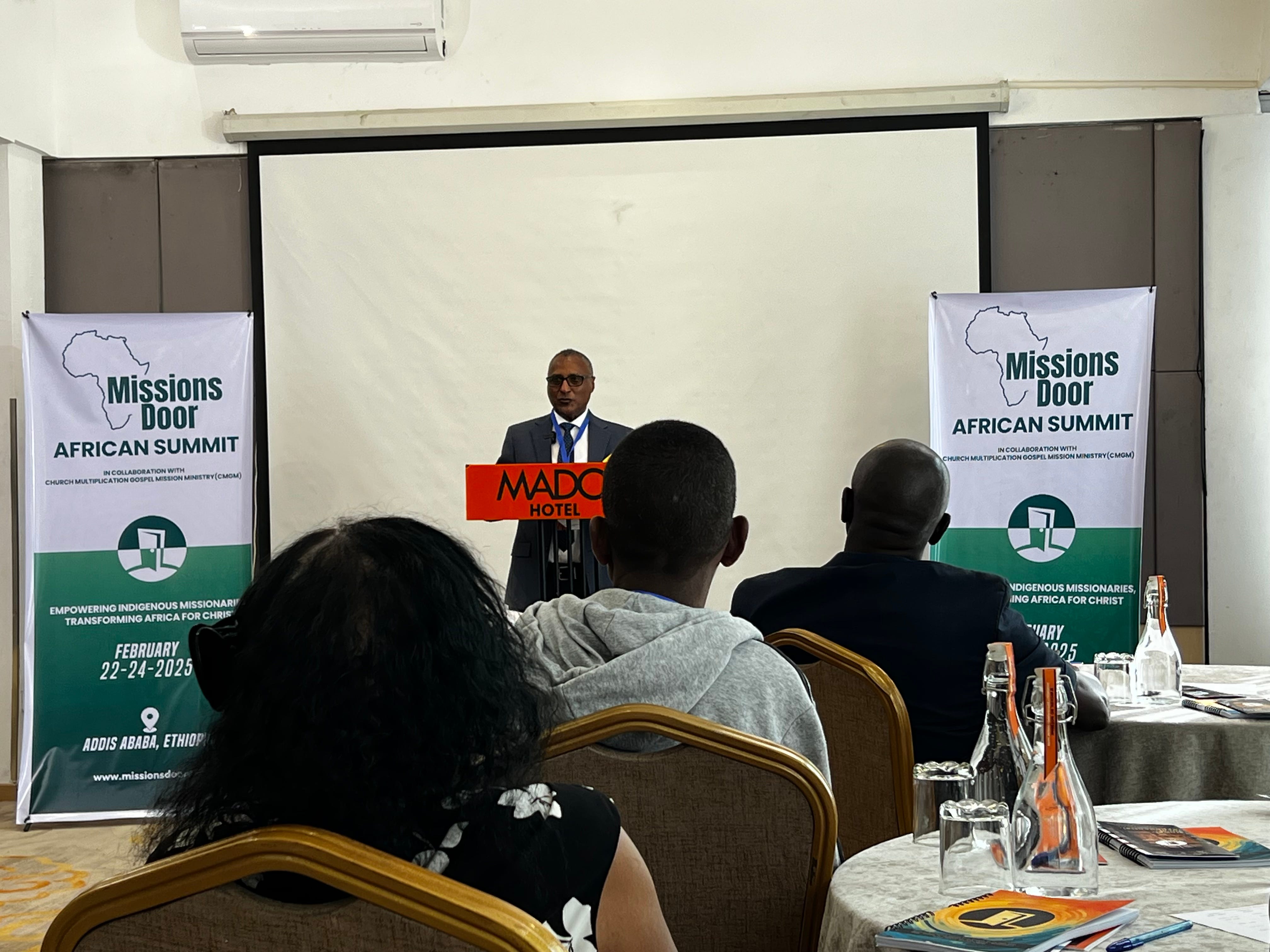
Last February, I had the privilege of being with Workneh in Addis Ababa for our first ever Missions Door African Summit. At Missions Door, our motto is “Global. Local. Exponential.” It’s a twist on the typical “Local. Global. Exponential.” way of thinking that tends to accompany the Great Commission (Matt. 28:19–20). We see that God calls local missionary multipliers to their peoples. Those peoples may be everywhere. We focus less on sending cross-culturally and more on igniting something within cultures and peoples. We see a global world, and from that global view, we see that God wants to do a powerful local work everywhere. Done with the right leader, that work goes exponential. These leaders are men and women like Workneh and Tersit Tesfaye. They may live in Boston, MA, but their reach is global.
God took a teen in line for execution and turned him into a missionary to his own people. He removed him from his country so that he could be effective wherever those peoples are, including in his home country. God moved him from a picture on a wall in a museum about death to sharing life with hundreds.
As we near the end of 2025, please give to Missions Door, or directly support missionaries within Missions Door: https://www.missionsdoor.org/give/
If you’ve ever watched the All Blacks play rugby, you’ve likely seen the Māori haka. The Māori are the Indigenous Polynesian people of Aotearoa/New Zealand. They share traits with other Polynesian cultures, including concepts of utu (reciprocity and revenge) that could involve sudden violence for perceived or real slights, and, in some traditional contexts, practices such as cannibalism or handling the remains of enemies as a way of transferring power. Like many traditional societies, they also held a hierarchy of spiritual beings (a mix of animism and polytheism) and a strong sense of spiritual interconnectedness between a person’s unique life force and a greater life force.
It was into this world that missionaries arrived. Timothy Yates’s book, The Conversion of the Maori: Years of Religious and Social Change, 1814–1842, is a well‑researched glimpse into the missionary effort among the Māori and is a very worthwhile read. Current historical work on missions is significantly revising the older, bleak narrative that simply equates missions with colonialism. More historians are finding that although most missionaries came from the West, many did not seek to colonize or ‘westernize’ in the usual sense; instead, they frequently opposed exploitative and dehumanizing practices directed at Indigenous peoples, sometimes standing firmly against their own sending cultures.
With a little common sense, this fits the logic of Christian mission. Missionaries go to other cultures because God has called them to love all peoples, even at the cost of their lives. Someone has to share the good news with ‘cannibals,’ even when doing so involves real danger (including being eaten!). For most missionaries, the motive is not conquest, but a) obedience to God and b) love for the people they are seeking to reach.
That means many missionaries function as practical cultural anthropologists. At times, missionaries have championed the dignity and value of the very cultures they came to serve so strongly that they have lost their way theologically. Every culture is fallen; some are simply more familiar to us. Every Christian is called to de‑prioritize their own culture in favor of the culture of the kingdom of God. Peter and Paul remind believers that, at conversion, our primary citizenship shifts to God’s kingdom, so that we live as ‘sojourners and exiles,’ no longer fully at home, but not home yet, and this enables us, however imperfectly, to see other cultures through a God‑sized lens. Yates notes that missionaries often served as peacemakers between warring Māori groups (p. 77).
It was an outstanding example of the need to bring the rule of law to bear on New Zealand, which was beset also by the activities of a number of escaped convicts from the colony who, with other lawless Europeans, earned the soubriquet “devils” from the Maori, a class of persons they were careful to distinguish from the missionaries, although there were occasions…when the categories began to overlap. - pp. 64
Missionaries in New Zealand often resisted attempts to force the Māori to conform to British standards, practices, and principles. They recognized that being British is not the same as being Christlike. They also tried not to impose cultural expectations that exceeded the spiritual maturity of new believers. “Missionaries of both missions were ever on the watch for an outward conformity unmatched by inner commitment” (65). The senior missionary sets the tone for the mission, and in Samuel Marsden, there was an excellent foundation. Even today, New Zealand is rather unique in the world in the way its European-descent and Maori-descent peoples respect one another.
Mission to New Zealand was not perfect. But then again, people are not perfect—neither the locals nor the cross‑cultural missionaries. A major reason for the effectiveness of Christian witness to the Maori was not the cross-cultural missionaries, but early Christian Maori, who behaved more lovingly and kindly as a result of encountering Jesus. These visible, positive lifestyle changes made a real difference.
An increasingly global connectedness also played a role. Missionaries were there before the colonization of New Zealand. For centuries, the Maori fought each other. But now there was a new outside threat forcing them to consider what united voice they might have to the outside world. But how could they find unity after centuries of tribal warfare and entrenched practices? Missionaries were a factor in helping the Maori understand their voice, regardless of whether they converted to Christianity.
This latter point is often overlooked. Do God’s people on mission want something from others? Yes. We want everyone to know and follow Jesus. But if they don’t does that mean we work against their betterment and well-being? No (emphatically so). And this is because God was for us long before we came to faith in Him. We extend the same kindness, love, and grace to others without much regard for what we receive in return. This does not mean Christians are weak or pushovers. We too must exercise discernment. But it does mean we have a propensity to extend grace where many don’t. That includes those who are radically different in thought, practice, lifestyle, and culture.
Do we seek change? Yes. We seek it not only in the world, but in ourselves. We’re being transformed into the likeness of Christ. We do not see ourselves as the agents of that change. It is the fear of most Christians that outward conformity would not reflect an inward conversion, so we tend to be careful about it. We’d rather have unpretentious honesty than pretend faith. And it’s the same Jesus who changes all peoples in all cultures from the inside out. So we seek signs of that common change, try to discern it from cultural comfortability, and move forward with new siblings reflecting characteristics associated with Jesus and reflected in Scripture.
Some like to point out we’re sometimes bad at it. And because we know our own fallenness, they are right! But the solution of “doing nothing” is no solution at all. Thankfully, we’ve a long history of godly men and women doing something well. Like critiquing parenting, it’s easy to do in retrospect. But in the moment, we do the best we can, trusting that God can use broken sticks like us to draw straight lines to Him.